Design Approach
We wanted to create a design that increased the quality of ecological function, ensured future resilience, had the potential to grow future timber trees – which will be an ongoing labour of love for me, add to the beauty of the local area and preserve a sense of the site, particularly the view of Caer Caradoc. It was also important that the site could be easily managed – for establishment (weeding and replacement planting) and for control of any deer and rabbits.
The first part of any design is to establish site conditions; this means assessing the soil and matching species that will grow now and in future modelled climate conditions. This give a list of trees that can then be refined to those that suit your objectives. Even on a small site like ours, there were 3 distinct soil types, which varied in terms of available moisture and, to a lesser degree, nutrients.
Constraints
We next had to understand whether there were threats and constraints to planting. Any planting needs to be screened by the government regulator, the Forestry Commission, to review whether any impact of land use change poses a significant impact to the local environment and the community. This is referred to as an Environmental Impact Assessment (EIA). It is possible, and highly advisable to check this beforehand. The government’s guidance on tree planting helps and there is a useful tool to check most issues: Land Information Search. We had checked this prior to purchasing the land and there were no significant constraints. The only issue raised in the EIA was the need to preserve the hedgerows as part of the historic field pattern of the area. This presented no issues as there are trees in the hedges which Jen has already been foraging from, including damson, sloe, hawthorn and crab apple. We can widen this to increase the amount of available fruit for us and also to provide an area suitable for bird nesting and pollinators, as well as creating structural diversity in the woodland that complements the other trees to be planted, which will grow to a greater height.
Another key issue to consider is whether there are any browsing threats. Deer, in particular, are at unnaturally high levels throughout the English countryside and present a threat to establishing trees. We spoke to a deer manager when creating the design to ensure that the layout and access allowed him to successfully manage any deer. The other issue comes from rabbits, which will also be managed in the wood. this means ensuring suitable infrastructure is correctly located and that open ground allows movement round the woodland.
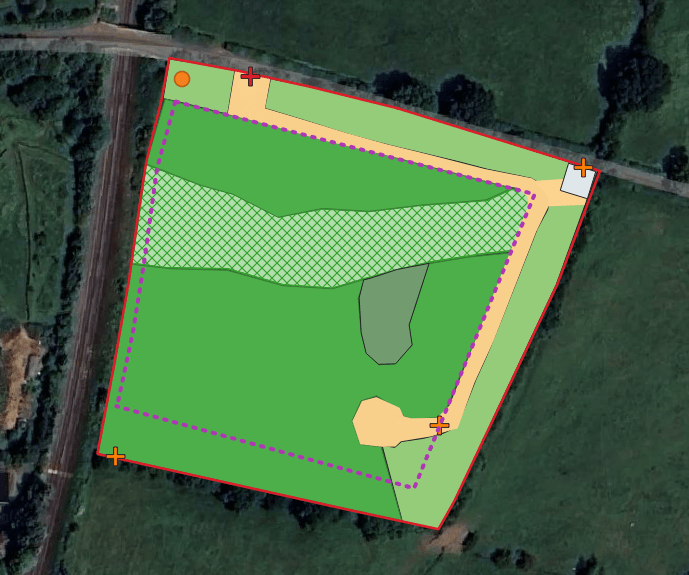
This is the final design, where the light green is lower spaced shrubs with cherry, aspen, alder and birch, the other areas will be planted at tighter spacing, which will be gradually managed to select the healthiest trees as they develop. Species are selected to match site conditions with oak and hornbeam clusters, lime and sweet chestnut mixes and alder, birch and cherry scattered throughout. Mixtures have been selected to suit microsite conditions as well as to grow well in balance together.
Tree selection
Details of planting are above, the breakdown of species is below. Asterisks represent seed provenances that have been specifically selected as a result of improved breeding programmes and are the target species for future timber trees.
| Species | Trees |
| Field maple | 50 |
| Common alder | 400 |
| Silver birch* | 280 |
| Hornbeam | 600 |
| Sweet chestnut | 230 |
| Hazel | 500 |
| Crab apple | 50 |
| Aspen* | 50 |
| Wild cherry* | 440 |
| Blackthorn | 50 |
| Pedunculate oak* | 720 |
| Elder | 50 |
| Small leaved lime | 250 |
| Large leaved lime | 200 |
 Struan's Wood